Apps need smartphones. Data services need GPRS, UMTS or LTE. USSD needs none. Reach 100% of your subscribers, including 2G handsets and roaming users, with real-time interactive services with up to several ten of thousands transactions per second.
Mobile banking, self-care, and account management apps require a smartphone, a data connection, and an installation. In markets where 2G or 3G penetration is high and data costs are significant and covering remote areas, a meaningful share of the subscriber base never reaches those services.
Operators who build service delivery entirely on apps exclude the subscribers who most need low-friction financial and account management tools. When a subscriber is roaming with data turned off or out of limit, every app-based service goes dark.
USSD works on every handset. No data connection. Bad network condition. No installation. A subscriber dials a short code, a menu appears, and the session completes in seconds.

Dial a short code, done in seconds
The simplest mobile interaction on any network is a short code. A subscriber dials it. A menu appears. The session is done in seconds: balance check, top-up, mobile money transfer, customer care. The interaction runs entirely on the signalling channel, so the handset generation and the data plan are irrelevant.
Push and Pull, SS7 or SIGTRAN
The Ouroboros USSD Gateway delivers these sessions via SS7, SIGTRAN. It handles both modes: Pull, where the subscriber initiates via short code, and Push, where the network initiates for proactive alerts and notifications. Multiple nodes share the same Point Code or Global Title with no architectural ceiling on scale.
Carrier-grade on COTS hardware
Service-side integration connects via HTTP, SQL, or SMPP. Charging can occurs via CAMEL or Diameter — per event, or per action.
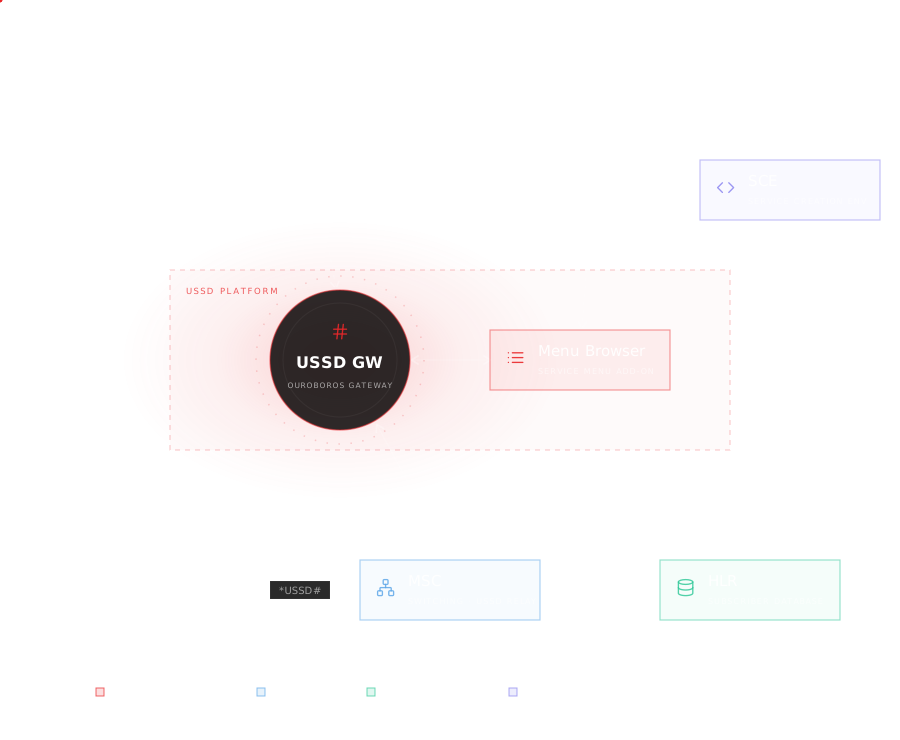
USSD platform — gateway, menu browser and VAS integration
Self-care, mobile money, location services, VAS onboarding, roaming — sessions that reach 99% of handsets.
Self-care for every subscriber
Balance, top-up, and service activation run as menu-driven sessions. The subscriber on a basic handset accesses the same self-care menu as a smartphone user, with no app to install and no data plan required.
Mobile banking and mobile money
Financial services over USSD reach the unbanked and underbanked. Transactions complete in a single session.
Location-based services
The optional GMLC module pulls subscriber location directly from the HLR/HSS. Location-aware services deploy without procuring a standalone location platform: nearest branch, local offers, emergency response.
VAS partner onboarding
VAS providers integrate via HTTP or SMPP. The Menu Browser lets operators deploy new service menus and modify existing ones without a gateway reconfiguration cycle. New partners go live on the operator's timeline.
Roaming subscriber engagement
Self-care, alerts, and account services stay live when a subscriber crosses a border. Service availability does not drop the moment they leave the home network.
M2M service
Suitable for M2M deployments where devices need to report status or trigger actions without a data session.
Operate others USSD services
Ouroboros USSD-GW can activate services from others USSD platforms providing evolved services or interopating with other MNO USSD services.
No other core network provider was able to offer a USSD Gateway as a rental service. The deployment went well in a very short time. The team is highly knowledgeable and very responsive. Service is working well. We are not disappointed.
Mark Muyenzi
CTO · Comzafrica
Push and Pull modes
Pull sessions are subscriber-initiated via short code. Push sessions are network-initiated. Both run on the same gateway. Proactive alerts and reactive self-care share one deployment. No second gateway for push notifications.
Embedded GMLC pull from HLR
Subscriber location is retrieved directly from the HLR inside the gateway. No external Location Services platform. Location-based USSD services deploy without adding another platform to the architecture.
Menu Browser add-on
New USSD menus and service modifications deploy through a management interface without changing core gateway configuration. Commercial and VAS teams launch new services without waiting on a gateway reconfiguration cycle.
Unlimited node scaling with shared Point Code
Multiple gateway nodes share the same Point Code or Global Title. Capacity scales by adding nodes. Transaction throughput grows with subscriber volume. No architectural ceiling, no re-addressing the network.
CAMEL and Diameter charging
Charging events report per action, per time unit, or per event to CAMEL or Diameter charging systems. Flat fee, time-based, and event-based monetisation models run on the same gateway.
Ouroboros was the first to offer the USSD Gateway as a rental service. For operators entering new markets or managing CAPEX tightly, OPEX rental changes the deployment decision.
The embedded GMLC removes a platform from the architecture. Most vendors require a standalone Location Services platform for location-aware USSD. Ouroboros includes it in the gateway.

Which services do you need to deliver over USSD, and what does your subscriber base look like? We'll propose a gateway configuration and capacity to match, on OPEX or CAPEX.
 Product datasheet
2G / 3G · 2G/3G Core
USSD Gateway
Apps need smartphones. Data services need GPRS, UMTS or LTE. USSD needs none. Reach 100% of your subscribers, including 2G handsets and roaming users, with real-time interactive services with up to several ten of thousands transactions per second.
Deployed across 30+ countries · First USSD Gateway offered as a rental service
The subscribers your app cannot reach
Mobile banking, self-care, and account management apps require a smartphone, a data connection, and an installation. In markets where 2G or 3G penetration is high and data costs are significant and covering remote areas, a meaningful share of the subscriber base never reaches those services.
Operators who build service delivery entirely on apps exclude the subscribers who most need low-friction financial and account management tools. When a subscriber is roaming with data turned off or out of limit, every app-based service goes dark.
USSD works on every handset. No data connection. Bad network condition. No installation. A subscriber dials a short code, a menu appears, and the session completes in seconds.
Every handset. No app. No data.
Dial a short code, done in seconds
The simplest mobile interaction on any network is a short code. A subscriber dials it. A menu appears. The session is done in seconds: balance check, top-up, mobile money transfer, customer care. The interaction runs entirely on the signalling channel, so the handset generation and the data plan are irrelevant.
Push and Pull, SS7 or SIGTRAN
The Ouroboros USSD Gateway delivers these sessions via SS7, SIGTRAN. It handles both modes: Pull, where the subscriber initiates via short code, and Push, where the network initiates for proactive alerts and notifications. Multiple nodes share the same Point Code or Global Title with no architectural ceiling on scale.
Carrier-grade on COTS hardware
Service-side integration connects via HTTP, SQL, or SMPP. Charging can occurs via CAMEL or Diameter — per event, or per action.
USSD platform — gateway, menu browser and VAS integration
How operators use it.
Self-care, mobile money, location services, VAS onboarding, roaming — sessions that reach 99% of handsets.
Self-care for every subscriber
Balance, top-up, and service activation run as menu-driven sessions. The subscriber on a basic handset accesses the same self-care menu as a smartphone user, with no app to install and no data plan required.
Mobile banking and mobile money
Financial services over USSD reach the unbanked and underbanked. Transactions complete in a single session.
Location-based services
The optional GMLC module pulls subscriber location directly from the HLR/HSS. Location-aware services deploy without procuring a standalone location platform: nearest branch, local offers, emergency response.
VAS partner onboarding
VAS providers integrate via HTTP or SMPP. The Menu Browser lets operators deploy new service menus and modify existing ones without a gateway reconfiguration cycle. New partners go live on the operator's timeline.
Roaming subscriber engagement
Self-care, alerts, and account services stay live when a subscriber crosses a border. Service availability does not drop the moment they leave the home network.
M2M service
Suitable for M2M deployments where devices need to report status or trigger actions without a data session.
Operate others USSD services
Ouroboros USSD-GW can activate services from others USSD platforms providing evolved services or interopating with other MNO USSD services.
“No other Core Network provider was able to offer a USSD Gateway as a rental service. The deployment went well in a very short time. The team is highly knowledgeable and very responsive.”
Mark Muyenzi
CTO · Comzafrica
Specifications.
Inside the platform.
Push and Pull modes
Pull sessions are subscriber-initiated via short code. Push sessions are network-initiated. Both run on the same gateway. Proactive alerts and reactive self-care share one deployment. No second gateway for push notifications.
Embedded GMLC pull from HLR
Subscriber location is retrieved directly from the HLR inside the gateway. No external Location Services platform. Location-based USSD services deploy without adding another platform to the architecture.
Menu Browser add-on
New USSD menus and service modifications deploy through a management interface without changing core gateway configuration. Commercial and VAS teams launch new services without waiting on a gateway reconfiguration cycle.
Unlimited node scaling with shared Point Code
Multiple gateway nodes share the same Point Code or Global Title. Capacity scales by adding nodes. Transaction throughput grows with subscriber volume. No architectural ceiling, no re-addressing the network.
CAMEL and Diameter charging
Charging events report per action, per time unit, or per event to CAMEL or Diameter charging systems. Flat fee, time-based, and event-based monetisation models run on the same gateway.
Ouroboros was the first to offer the USSD Gateway as a rental service. For operators entering new markets or managing CAPEX tightly, OPEX rental changes the deployment decision.
The embedded GMLC removes a platform from the architecture. Most vendors require a standalone Location Services platform for location-aware USSD. Ouroboros includes it in the gateway.
USSI
Ouroboros USSI-GW handles USSD on IMS to continue to provide usual USSD service on voLTE/voWifi.
HLR
The embedded GMLC pulls subscriber location directly from the HLR. No external platform required.
SMSC
USSD handles real-time interactive sessions. SMSC handles store-and-forward notifications. The two work together for complete messaging coverage.
Next step
Which USSD services has no web interface counterpart.
Which services do you need to deliver over USSD, and what does your subscriber base look like? We'll propose a gateway configuration and capacity to match, on OPEX or CAPEX.