Every voice call your subscribers receive passes through a gateway. If that gateway belongs to your host MNO, so does the routing margin. Deploy your own GMSC and keep it.
A light MVNO routes every incoming voice call through its host MNO's gateway. The host MNO picks the route. The host MNO earns the margin. At low subscriber counts that arrangement works. At scale, it is a structural cost built into every call — one the operator cannot optimise because they do not control the routing.
The answer is a GMSC. But the vendors who build GMSCs build them for networks with hundreds of E1s and millions of subscribers. The entry point, the hardware assumptions, and the minimum contract size all reflect that.
Most MVNOs reach the point where routing margins matter before they reach the point where those vendors will take the call.

Every terminating call goes through
Every voice call that terminates on a mobile network goes through a GMSC. It queries the HLR to locate the destination subscriber, selects a route to the serving MSC, and hands the call off. Without one, incoming calls from the PSTN or other carriers cannot reach your subscribers. With a host MNO's GMSC, every one of those decisions belongs to someone else.
Routing under your control
The Ouroboros GMSC puts that routing under the operator's control. You choose the peer. You set the route. You keep the margin.
Starts at 2U, scales without forklift
The platform starts at 2U. The MSS component virtualises for NFV infrastructure. Capacity scales via IP, E1s, or STM-1 as the network grows — no forklift upgrade. Route logic customises by dialled number, dialling number, and incoming trunk simultaneously. Geographically distributed nodes share one centralised routing configuration. Cluster deployment delivers high availability for business continuity.
Optional modules, one platform
Optional modules cover CAMEL Phase 2 and 4 SSF for IN services, INAP CS1 SSF for legacy networks, Diameter Ro for 4G billing in SCUR mode, CAMEL Phase 2 SRF with VXML for integrated IVR, and Mobile Number Portability per country.
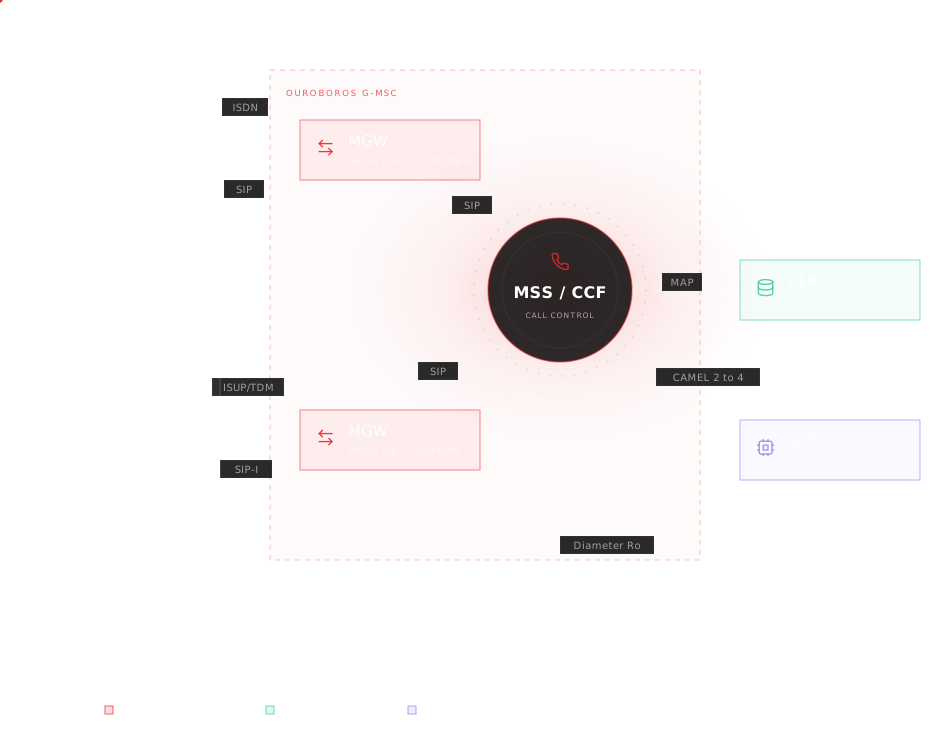
G-MSC — MSS/CCF call control with dual-site media gateways
Routing margins, IN services, 4G billing, MNP — one gateway, sized to where the operator is now.
MVNO moving from light to full
An MVNO that has grown past the point where host MNO routing margins are negligible deploys its own GMSC to establish direct peer interconnects. The 2U minimum and OPEX rental make the cost proportional to where the operator is now, not where it hopes to be.
Multi-country routing with distributed nodes
Operators with footprints across multiple geographies need routing decisions that account for dialled number, dialling number, and incoming trunk across all sites. One centralised configuration applies consistently across nodes in multiple locations.
IN services via CAMEL
The GMSC triggers CAMEL to an SCP for prepaid call control, number translation, and VMS failed call forwarding — without reprogramming individual switching elements.
4G billing via Diameter Ro
Operators with LTE subscribers and an OCS connect via the Diameter Ro interface in SCUR mode. Convergent billing runs across the same GMSC without a separate platform.
Mobile Number Portability
MNP deploys per country's regulatory framework as a configurable module — not a standalone system procured separately.

We've selected Ouroboros because it was the best company capable of fulfilling our need for a scalable and virtualised full MVNO platform. Moreover, the Ouroboros team is pragmatic, flexible and responsive.
Pascal Prot
CEO-CTO · Legos
CAMEL Phase 2 and 4 SSF
The GMSC triggers IN services at the SCP on every qualifying call: prepaid balance check, number translation, VMS handling. IN services deploy from the SCP without touching GMSC routing configuration.
Diameter Ro interface (SCUR mode)
Connects to an OCS for real-time 4G charging via standard Diameter credit control. LTE subscribers bill through the same GMSC without a separate packet billing gateway.
High-level route customisation
Routing decisions evaluate dialled number, dialling number, and incoming trunk simultaneously against a configurable decision table. Complex peering agreements apply automatically. No manual per-call logic.
Geographic split with centralised routing
Gateway nodes deploy across multiple locations. All routing policy is managed from one central configuration. Multi-site redundancy without duplicated configuration management overhead.
MSS component virtualisation
The Mobile Softswitch element runs on virtual infrastructure alongside bare-metal gateway components. Deploy on existing NFV infrastructure. No dedicated physical rack for the GMSC.
CAMEL Phase 2 SRF with VXML
Integrated IVR capability runs inside the GMSC platform. VXML scenarios define the menu logic. No separate IVR platform to procure, integrate, or maintain.
MNP per country
Mobile Number Portability is designed and deployed per the regulatory framework of each country. Number portability compliance without a standalone MNP platform.
Carrier-grade GMSC capability from a vendor sized for the operators who need it — not the operators who can absorb a seven-figure contract. The full protocol set is there: ISUP, SIP, CAMEL, Diameter Ro, MNP. The entry point is 2U with OPEX rental. The platform that serves a 50,000-subscriber MVNO is the same platform running on networks for STC, Orange, and Etisalat.
That is the point. You do not outgrow it.

Tell us your current subscriber count and how voice termination works today. We'll size a GMSC deployment matched to where you are now — OPEX or CAPEX, bare metal or virtualised.
 Product datasheet
2G / 3G · 2G/3G Core
Gateway Mobile Switching Center (GMSC)
Every voice call your subscribers receive passes through a gateway. If that gateway belongs to your host MNO, so does the routing margin. Deploy your own GMSC and keep it.
Part of the platform running 148M+ subscribers across 30+ countries
The routing margin you hand to your host MNO
A light MVNO routes every incoming voice call through its host MNO's gateway. The host MNO picks the route. The host MNO earns the margin. At low subscriber counts that arrangement works. At scale, it is a structural cost built into every call — one the operator cannot optimise because they do not control the routing.
The answer is a GMSC. But the vendors who build GMSCs build them for networks with hundreds of E1s and millions of subscribers. The entry point, the hardware assumptions, and the minimum contract size all reflect that.
Most MVNOs reach the point where routing margins matter before they reach the point where those vendors will take the call.
Your gateway. Your routes. Your margin.
Every terminating call goes through
Every voice call that terminates on a mobile network goes through a GMSC. It queries the HLR to locate the destination subscriber, selects a route to the serving MSC, and hands the call off. Without one, incoming calls from the PSTN or other carriers cannot reach your subscribers. With a host MNO's GMSC, every one of those decisions belongs to someone else.
Routing under your control
The Ouroboros GMSC puts that routing under the operator's control. You choose the peer. You set the route. You keep the margin.
Starts at 2U, scales without forklift
The platform starts at 2U. The MSS component virtualises for NFV infrastructure. Capacity scales via IP, E1s, or STM-1 as the network grows — no forklift upgrade. Route logic customises by dialled number, dialling number, and incoming trunk simultaneously. Geographically distributed nodes share one centralised routing configuration. Cluster deployment delivers high availability for business continuity.
Optional modules, one platform
Optional modules cover CAMEL Phase 2 and 4 SSF for IN services, INAP CS1 SSF for legacy networks, Diameter Ro for 4G billing in SCUR mode, CAMEL Phase 2 SRF with VXML for integrated IVR, and Mobile Number Portability per country.
G-MSC — MSS/CCF call control with dual-site media gateways
How operators use it.
Routing margins, IN services, 4G billing, MNP — one gateway, sized to where the operator is now.
MVNO moving from light to full
An MVNO that has grown past the point where host MNO routing margins are negligible deploys its own GMSC to establish direct peer interconnects. The 2U minimum and OPEX rental make the cost proportional to where the operator is now, not where it hopes to be.
Multi-country routing with distributed nodes
Operators with footprints across multiple geographies need routing decisions that account for dialled number, dialling number, and incoming trunk across all sites. One centralised configuration applies consistently across nodes in multiple locations.
IN services via CAMEL
The GMSC triggers CAMEL to an SCP for prepaid call control, number translation, and VMS failed call forwarding — without reprogramming individual switching elements.
4G billing via Diameter Ro
Operators with LTE subscribers and an OCS connect via the Diameter Ro interface in SCUR mode. Convergent billing runs across the same GMSC without a separate platform.
Mobile Number Portability
MNP deploys per country's regulatory framework as a configurable module — not a standalone system procured separately.
“We've selected Ouroboros because it was the best company capable of fulfilling our need for a scalable and virtualised full MVNO platform. Moreover, the Ouroboros team is pragmatic, flexible and responsive.”
Pascal Prot
CEO-CTO · Legos
Specifications.
Inside the platform.
CAMEL Phase 2 and 4 SSF
The GMSC triggers IN services at the SCP on every qualifying call: prepaid balance check, number translation, VMS handling. IN services deploy from the SCP without touching GMSC routing configuration.
Diameter Ro interface (SCUR mode)
Connects to an OCS for real-time 4G charging via standard Diameter credit control. LTE subscribers bill through the same GMSC without a separate packet billing gateway.
High-level route customisation
Routing decisions evaluate dialled number, dialling number, and incoming trunk simultaneously against a configurable decision table. Complex peering agreements apply automatically. No manual per-call logic.
Geographic split with centralised routing
Gateway nodes deploy across multiple locations. All routing policy is managed from one central configuration. Multi-site redundancy without duplicated configuration management overhead.
MSS component virtualisation
The Mobile Softswitch element runs on virtual infrastructure alongside bare-metal gateway components. Deploy on existing NFV infrastructure. No dedicated physical rack for the GMSC.
CAMEL Phase 2 SRF with VXML
Integrated IVR capability runs inside the GMSC platform. VXML scenarios define the menu logic. No separate IVR platform to procure, integrate, or maintain.
MNP per country
Mobile Number Portability is designed and deployed per the regulatory framework of each country. Number portability compliance without a standalone MNP platform.
Carrier-grade GMSC capability from a vendor sized for the operators who need it — not the operators who can absorb a seven-figure contract. The full protocol set is there: ISUP, SIP, CAMEL, Diameter Ro, MNP. The entry point is 2U with OPEX rental. The platform that serves a 50,000-subscriber MVNO is the same platform running on networks for STC, Orange, and Etisalat.
That is the point. You do not outgrow it.
Home Location Register (HLR)
The GMSC queries the HLR on every incoming call to locate the destination subscriber before routing.
Service Control Point (SCP)
CAMEL triggers from the GMSC reach the SCP on inbound and outbound calls for IN services and real-time billing.
Next step
Still routing calls through your host MNO?
Tell us your current subscriber count and how voice termination works today. We'll size a GMSC deployment matched to where you are now — OPEX or CAPEX, bare metal or virtualised.