Every LTE data session exits the Evolved Packet Core through the PDN-GW. It enforces QoS, generates charging events, and connects subscribers to external IP networks. If you are planning 5G SA, it also needs to evolve into SMF and UPF, without a replacement.
LTE data traffic terminates at the PDN-GW before reaching the internet or private networks. An undersized or poorly configured gateway creates the bottleneck subscribers notice first: high latency on VoIP, throttled video streams, emergency sessions competing with background downloads.
Operators building toward 5G SA face a structural problem on top of that. The 4G PDN-GW function splits into SMF and UPF in a 5G core. A gateway that cannot evolve means a full replacement at 5G launch — another procurement, another integration, another migration event at exactly the point where engineering teams are most stretched.

Every packet exits here
Every packet that leaves or enters an LTE subscriber's session passes through the PDN-GW. It is the egress point for the Evolved Packet Core: it connects to the public internet, enterprise VPNs, and IMS infrastructure for VoLTE. It is also where per-user QoS rules are applied and charging events are generated for every active session.
PCEF built in, PCRF optional
The Ouroboros PDN-GW includes the Policy and Charging Enforcement Function built in. When a PCRF is present, QoS rules apply over the Gx interface in real time. For lean deployments without a PCRF or external OCS, the PDN-GW operates with local policy and charging configuration. Third-party OCS and PCRF platforms connect via standard interfaces.
GGSN → PDN-GW → SMF/UPF
The same platform handles GGSN function for 2G/3G sessions and carries forward to part of the SMF/UPF split in 5G SA. Operators moving to 5G extend the gateway rather than swap it out. The distributed P-Gateway architecture places gateway function closer to the subscriber, reducing round-trip latency for edge applications. IPv4 and IPv6 are both supported natively.
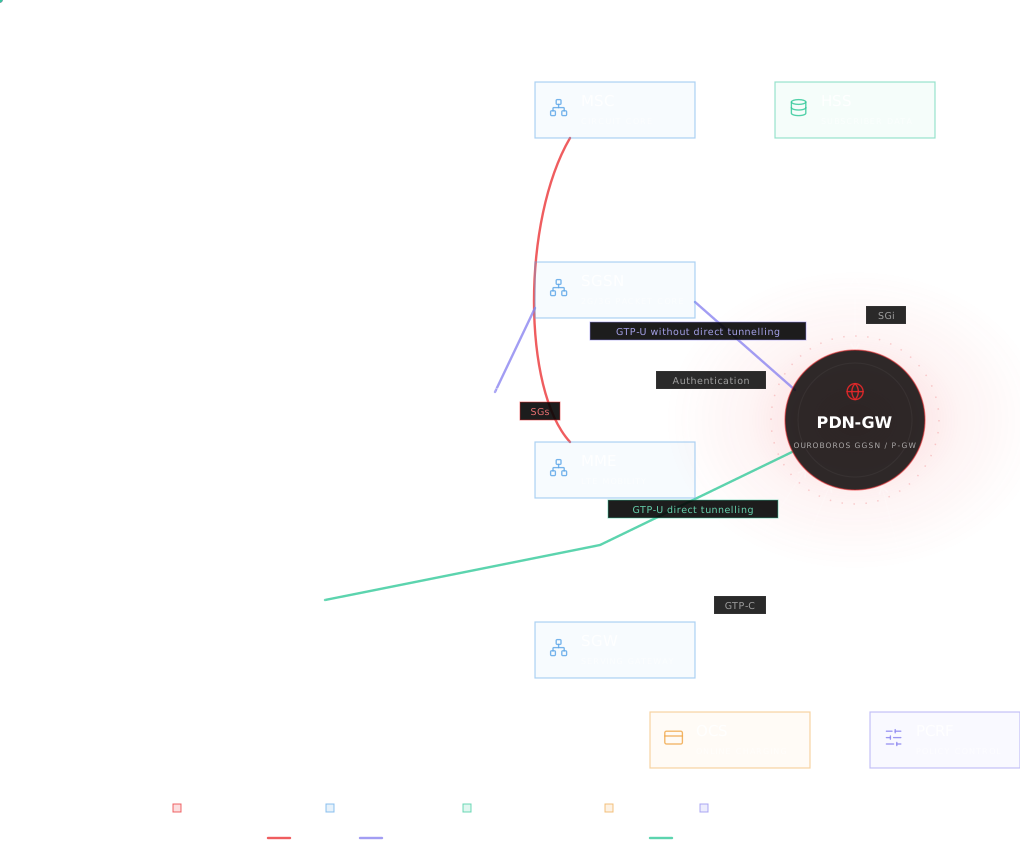
PDN-GW — 2G/3G/4G payload paths into one gateway
National LTE, VoLTE bearers, private-network bandwidth, lean cores, 5G SA — one egress point.
LTE data access — national MNO
All subscriber data sessions route through the PDN-GW to external IP networks. Per-user QoS ensures premium subscribers receive their contracted bitrate. Congestion control limits the impact of high-volume sessions on other users without manual intervention.
VoLTE and emergency services
VoLTE sessions require dedicated IMS bearers with guaranteed bitrate and packet loss targets. The PDN-GW creates and maintains the IMS PDN connection alongside the standard internet PDN. Emergency sessions receive absolute priority.
Bandwidth management for private LTE
A private LTE network with finite backhaul uses the PDN-GW to enforce per-device or per-application bandwidth limits, preventing a single device from saturating shared uplink capacity during critical operations.
Lean deployment without PCRF
Operators who do not need dynamic per-session policy control deploy the PDN-GW with local QoS configuration. Full operation without PCRF, OCS, or OFCS reduces core network complexity for smaller deployments.
5G SA transition
Operators with a 5G SA roadmap run the Ouroboros PDN-GW knowing the platform covers the SMF/UPF function at 5G launch. The 5G migration extends the existing platform — it does not replace it.

Ouroboros is more agile and flexible than bigger ones. Its prices are competitive. The genuine expertise of the team enables a true dialogue with our partners.
Frédéric Maro
VP Network & Advanced Projects · Sierra Wireless
PCEF integrated: per-user QoS and charging
The Policy and Charging Enforcement Function is built in. No separate enforcement point required. QoS and charging rules apply at the packet level for every active session without an additional deployment.
Operates without PCRF or OCS
Local QoS and charging policy runs autonomously without an external policy or charging system. Lean deployments stay functional with a smaller core network footprint from day one.
Multi-generation function: GGSN to PDN-GW to SMF/UPF
The same platform handles 2G/3G, 4G, and 5G SA data gateway functions. Operators crossing generation boundaries do not replace the gateway at each transition.
Distributed P-Gateway architecture
Gateway function distributes across nodes, placing data plane processing closer to the RAN. Round-trip latency reduces for data sessions without adding backhaul hops.
IPv4 and IPv6 native support
Dual-stack operation assigns and routes both address families per session. Operators moving to IPv6-only or running dual-stack subscriber bases require no additional configuration.
Third-party PCRF and OCS integration
Standard Gx and Gy interfaces connect to external policy and charging platforms from any vendor. Operators with an existing charging stack integrate without replacing those systems.
Congestion control
Active congestion detection reduces bearer priority for high-volume sessions during peak load. Real-time services maintain acceptable quality without manual network intervention.
One platform covers GGSN function for 2G/3G, PDN-GW function for LTE, and the SMF/UPF path for 5G SA. Operators managing a network that spans generations do not procure a new data gateway at each transition. They configure the existing platform.
The PCEF is built in. For lean deployments, the platform runs without PCRF or OCS. For full deployments, it connects to any standards-compliant policy or charging system. OPEX rental is available — no capital commitment before the network generates data revenue.
In production since 2004, on networks including STC, Orange, Etisalat, and Zain.

Tell us your current packet core vendor, data throughput targets, and 5G timeline. We'll confirm how the PDN-GW covers both — and what the extension to SMF/UPF looks like.
 Product datasheet
4G / LTE · 4G/LTE
Packet Data Network Gateway (PDN-GW)
Every LTE data session exits the Evolved Packet Core through the PDN-GW. It enforces QoS, generates charging events, and connects subscribers to external IP networks. If you are planning 5G SA, it also needs to evolve into SMF and UPF, without a replacement.
In production since 2004 · OPEX rental available · 99.999% availability
The bottleneck subscribers notice first
LTE data traffic terminates at the PDN-GW before reaching the internet or private networks. An undersized or poorly configured gateway creates the bottleneck subscribers notice first: high latency on VoIP, throttled video streams, emergency sessions competing with background downloads.
Operators building toward 5G SA face a structural problem on top of that. The 4G PDN-GW function splits into SMF and UPF in a 5G core. A gateway that cannot evolve means a full replacement at 5G launch — another procurement, another integration, another migration event at exactly the point where engineering teams are most stretched.
The egress point. Every generation.
Every packet exits here
Every packet that leaves or enters an LTE subscriber's session passes through the PDN-GW. It is the egress point for the Evolved Packet Core: it connects to the public internet, enterprise VPNs, and IMS infrastructure for VoLTE. It is also where per-user QoS rules are applied and charging events are generated for every active session.
PCEF built in, PCRF optional
The Ouroboros PDN-GW includes the Policy and Charging Enforcement Function built in. When a PCRF is present, QoS rules apply over the Gx interface in real time. For lean deployments without a PCRF or external OCS, the PDN-GW operates with local policy and charging configuration. Third-party OCS and PCRF platforms connect via standard interfaces.
GGSN → PDN-GW → SMF/UPF
The same platform handles GGSN function for 2G/3G sessions and carries forward to part of the SMF/UPF split in 5G SA. Operators moving to 5G extend the gateway rather than swap it out. The distributed P-Gateway architecture places gateway function closer to the subscriber, reducing round-trip latency for edge applications. IPv4 and IPv6 are both supported natively.
PDN-GW — 2G/3G/4G payload paths into one gateway
How operators use it.
National LTE, VoLTE bearers, private-network bandwidth, lean cores, 5G SA — one egress point.
LTE data access — national MNO
All subscriber data sessions route through the PDN-GW to external IP networks. Per-user QoS ensures premium subscribers receive their contracted bitrate. Congestion control limits the impact of high-volume sessions on other users without manual intervention.
VoLTE and emergency services
VoLTE sessions require dedicated IMS bearers with guaranteed bitrate and packet loss targets. The PDN-GW creates and maintains the IMS PDN connection alongside the standard internet PDN. Emergency sessions receive absolute priority.
Bandwidth management for private LTE
A private LTE network with finite backhaul uses the PDN-GW to enforce per-device or per-application bandwidth limits, preventing a single device from saturating shared uplink capacity during critical operations.
Lean deployment without PCRF
Operators who do not need dynamic per-session policy control deploy the PDN-GW with local QoS configuration. Full operation without PCRF, OCS, or OFCS reduces core network complexity for smaller deployments.
5G SA transition
Operators with a 5G SA roadmap run the Ouroboros PDN-GW knowing the platform covers the SMF/UPF function at 5G launch. The 5G migration extends the existing platform — it does not replace it.
“Ouroboros is more agile and flexible than bigger ones. Its prices are competitive. The genuine expertise of the team enables a true dialogue with our partners.”
Frédéric Maro
VP Network & Advanced Projects · Sierra Wireless
Specifications.
Inside the platform.
PCEF integrated: per-user QoS and charging
The Policy and Charging Enforcement Function is built in. No separate enforcement point required. QoS and charging rules apply at the packet level for every active session without an additional deployment.
Operates without PCRF or OCS
Local QoS and charging policy runs autonomously without an external policy or charging system. Lean deployments stay functional with a smaller core network footprint from day one.
Multi-generation function: GGSN to PDN-GW to SMF/UPF
The same platform handles 2G/3G, 4G, and 5G SA data gateway functions. Operators crossing generation boundaries do not replace the gateway at each transition.
Distributed P-Gateway architecture
Gateway function distributes across nodes, placing data plane processing closer to the RAN. Round-trip latency reduces for data sessions without adding backhaul hops.
IPv4 and IPv6 native support
Dual-stack operation assigns and routes both address families per session. Operators moving to IPv6-only or running dual-stack subscriber bases require no additional configuration.
Third-party PCRF and OCS integration
Standard Gx and Gy interfaces connect to external policy and charging platforms from any vendor. Operators with an existing charging stack integrate without replacing those systems.
Congestion control
Active congestion detection reduces bearer priority for high-volume sessions during peak load. Real-time services maintain acceptable quality without manual network intervention.
One platform covers GGSN function for 2G/3G, PDN-GW function for LTE, and the SMF/UPF path for 5G SA. Operators managing a network that spans generations do not procure a new data gateway at each transition. They configure the existing platform.
The PCEF is built in. For lean deployments, the platform runs without PCRF or OCS. For full deployments, it connects to any standards-compliant policy or charging system. OPEX rental is available — no capital commitment before the network generates data revenue.
In production since 2004, on networks including STC, Orange, Etisalat, and Zain.
vEPC (MME / SGW / PGW)
The PDN-GW is the PGW component of the vEPC. Operators who need the complete EPC bundle deploy the vEPC; operators who need only the data gateway deploy the PDN-GW standalone.
PCRF
The PDN-GW enforces PCRF policy rules at the packet level over Gx. The two form the complete policy and enforcement chain.
Home Subscriber Server (HSS)
Subscriber profile data from the HSS informs the APN configuration and PDN connection parameters set up at the PDN-GW.
Next step
Running LTE data today with a 5G SA roadmap?
Tell us your current packet core vendor, data throughput targets, and 5G timeline. We'll confirm how the PDN-GW covers both — and what the extension to SMF/UPF looks like.