Real-time SS7 and SIGTRAN signalling routing for 2G to 3G networks, handling both PCM SS7 on COTS hardware and IP signalling on cloud.
Every network element generates signalling. The MSC, HLR, SMSC, and the rest all need to exchange SS7 messages to set up calls, deliver SMS, and look up subscribers. Without a routing hub, each element has to address every other element directly, and every interconnect with another operator adds another set of direct links to maintain.
Operators also run two kinds of signalling at once. Legacy network elements speak PCM SS7. Newer elements speak SIGTRAN : SS7 over IP. A network that cannot route both on one platform ends up maintaining two signalling layers, each with its own configuration and failure points.

The mesh grows without an STP
The STP is the signalling routing hub of the network. Every SS7 message from an MSC, HLR, SMSC, or external operator arrives at the STP, which routes it to its destination based on Point Code, Global Title, and other addressing criteria. Elements no longer need to address each other directly. They address the STP. The star topology reduces the number of links and reduce latency.
Connect once to the STP pair
The Ouroboros STP handles both legacy PCM SS7 links, Low Speed Links and High Speed Links, and SIGTRAN M3UA (SS7 over IP).
Global Title routes the query
It deploys on COTS hardware. No proprietary signalling chassis is required.
Number portability, handled centrally
Number portability is handled centrally. The STP rewrites the Global Title of ported-in and ported-out subscribers and runs MNP for the whole 2G/3G network, across one country or several.
Slice the HLR and SCP from one point
It also extends HLR and SCP slicing from a central point. Capacity grows by adding nodes behind the STP rather than replacing the legacy platform outright.
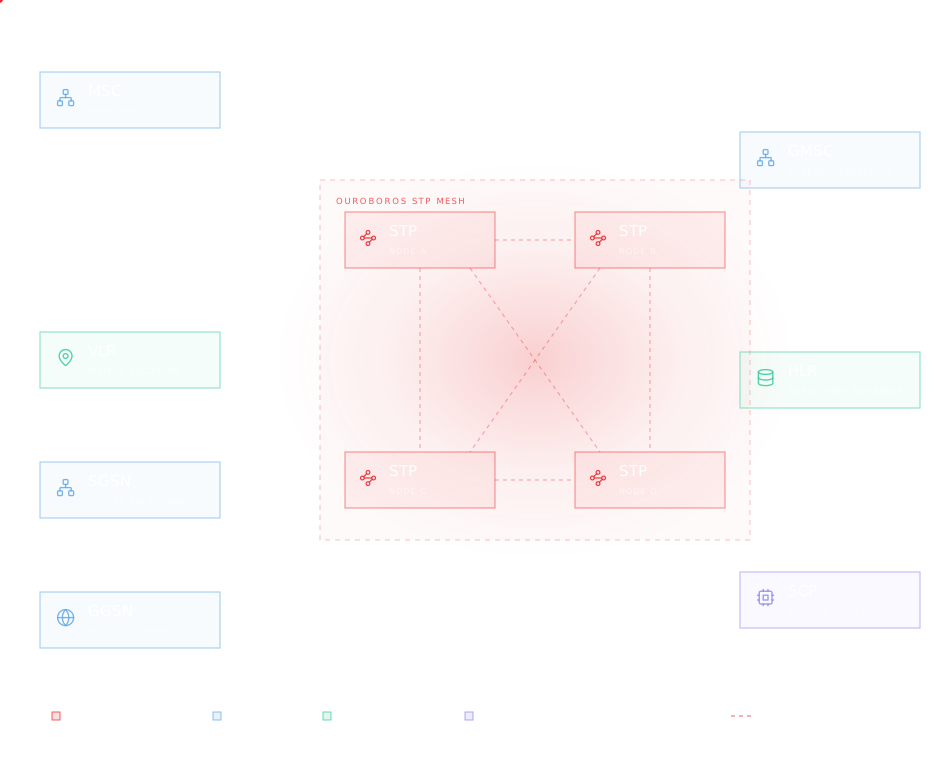
STP — redundant signalling pair
Hub-and-spoke signalling, SS7-SIGTRAN bridging, roaming routing, GT translation, SS7 screening — one platform.
Consolidating legacy and IP signalling
An operator running both PCM SS7 and SIGTRAN routes both through one STP. The legacy and IP signalling layers share a single routing configuration instead of two separate platforms.
Inter-operator interconnect
Signalling to and from external operators is routed and screened at the STP. Rules determine which links should be used per destination, commercial contract...
Internal signalling routing
SS7 between the MSC, HLR, SMSC, and other elements is relayed through the STP by Point Code and Global Title. Adding or moving an element updates the STP routing table rather than every element it talks to.

We've selected Ouroboros because it was the best company capable of fulfilling our need for a scalable and virtualised full MVNO platform. Moreover, the Ouroboros team is pragmatic, flexible and responsive.
Pascal Prot
CEO-CTO · Legos
PCM SS7 and SIGTRAN on one platform
The STP routes legacy PCM SS7 links (LSL and HSL) and SS7 over IP through the same platform. Legacy and IP signalling run through one routing hub. No second platform for the IP signalling layer.
Point Code and Global Title routing
Messages route to Signalling End Points by Point Code, Global Title, and other addressing criteria. Network elements address the STP, not each other. Adding an element is a routing-table change.
COTS hardware deployment
The STP runs on standard commercial hardware. No proprietary signalling chassis to procure or maintain.
The STP covers 2G to 3G signalling on one platform, routing both legacy PCM SS7 and SIGTRAN. It runs on COTS hardware as part of a platform in production since 2004 across 30+ countries.

Tell us your current signalling topology: PCM SS7, SIGTRAN, and the elements you need to route between. We'll confirm the right STP configuration for your network.
 Product datasheet
2G / 3G · 2G/3G Core
Signaling Transfer Point (STP)
Real-time SS7 and SIGTRAN signalling routing for 2G to 3G networks, handling both PCM SS7 on COTS hardware and IP signalling on cloud.
148M+ subscribers · 30+ countries
When every element has to talk to every other element
Every network element generates signalling. The MSC, HLR, SMSC, and the rest all need to exchange SS7 messages to set up calls, deliver SMS, and look up subscribers. Without a routing hub, each element has to address every other element directly, and every interconnect with another operator adds another set of direct links to maintain.
Operators also run two kinds of signalling at once. Legacy network elements speak PCM SS7. Newer elements speak SIGTRAN : SS7 over IP. A network that cannot route both on one platform ends up maintaining two signalling layers, each with its own configuration and failure points.
One connection. Every destination.
The mesh grows without an STP
The STP is the signalling routing hub of the network. Every SS7 message from an MSC, HLR, SMSC, or external operator arrives at the STP, which routes it to its destination based on Point Code, Global Title, and other addressing criteria. Elements no longer need to address each other directly. They address the STP. The star topology reduces the number of links and reduce latency.
Connect once to the STP pair
The Ouroboros STP handles both legacy PCM SS7 links, Low Speed Links and High Speed Links, and SIGTRAN M3UA (SS7 over IP).
Global Title routes the query
It deploys on COTS hardware. No proprietary signalling chassis is required.
Number portability, handled centrally
Number portability is handled centrally. The STP rewrites the Global Title of ported-in and ported-out subscribers and runs MNP for the whole 2G/3G network, across one country or several.
Slice the HLR and SCP from one point
It also extends HLR and SCP slicing from a central point. Capacity grows by adding nodes behind the STP rather than replacing the legacy platform outright.
STP — redundant signalling pair
How operators use it.
Hub-and-spoke signalling, SS7-SIGTRAN bridging, roaming routing, GT translation, SS7 screening — one platform.
Consolidating legacy and IP signalling
An operator running both PCM SS7 and SIGTRAN routes both through one STP. The legacy and IP signalling layers share a single routing configuration instead of two separate platforms.
Inter-operator interconnect
Signalling to and from external operators is routed and screened at the STP. Rules determine which links should be used per destination, commercial contract...
Internal signalling routing
SS7 between the MSC, HLR, SMSC, and other elements is relayed through the STP by Point Code and Global Title. Adding or moving an element updates the STP routing table rather than every element it talks to.
Specifications.
Inside the platform.
PCM SS7 and SIGTRAN on one platform
The STP routes legacy PCM SS7 links (LSL and HSL) and SS7 over IP through the same platform. Legacy and IP signalling run through one routing hub. No second platform for the IP signalling layer.
Point Code and Global Title routing
Messages route to Signalling End Points by Point Code, Global Title, and other addressing criteria. Network elements address the STP, not each other. Adding an element is a routing-table change.
COTS hardware deployment
The STP runs on standard commercial hardware. No proprietary signalling chassis to procure or maintain.
The STP covers 2G to 3G signalling on one platform, routing both legacy PCM SS7 and SIGTRAN. It runs on COTS hardware as part of a platform in production since 2004 across 30+ countries.
HLR
Signalling between the MSC and HLR is routed through the STP on every subscriber lookup.
GMSC
Voice call signalling between the GMSC and the rest of the network passes through the STP.
Next step
Routing legacy and IP signalling on separate platforms?
Tell us your current signalling topology: PCM SS7, SIGTRAN, and the elements you need to route between. We'll confirm the right STP configuration for your network.