A prepaid subscriber starts a call, a data session, and an SMS in the same minute. Each one has to check the same balance, reserve against it, and debit it — in real time, without double-spending. The Ouroboros OCS does that on the same UDR your HSS already uses, so subscriber identity and balance are one repository, not two systems to reconcile.
The HSS holds subscriber identity, profile, and provisioning state. The charging system holds balances, quotas, and rate plans. In most deployments these are separate products with separate databases — which means the same subscriber exists twice, and the two copies drift.
When provisioning changes in one system and not the other, sessions get authorised against stale data: a barred subscriber who still has balance, a balance that does not reflect a plan change, a profile update that never reached charging. Reconciliation jobs paper over the gap, but the underlying problem is architectural — subscriber data and charging data should not live in two repositories that have to be kept in sync.

Call or session starts — OCS authorises the balance
The Ouroboros OCS performs real-time online charging — balance check, quota reservation, and debit — for prepaid voice, data, and messaging across 2G, 3G, 4G, and 5G. Network elements request credit control over Diameter: the OCF/SCP interface to the packet core (Gy for the PGW, N40 for the 5G SMF/CHF role) and Ro for IMS-based services. Each request reserves a quota against the subscriber's balance and reports usage back, so charging tracks consumption as it happens rather than after the fact.
Rating engine applies the plan — per-PLMN rules
What makes this OCS different is where the balance lives. Instead of its own subscriber store, the OCS uses the same UDR (User Data Repository) as the HSS. Subscriber identity, profile, and balance are held in one repository, accessed by both functions. There is one record per subscriber, not two: the HSS reads and writes profile and provisioning state; the OCS reads and writes balances, quotas, and rate-plan state — against the same subscriber entity.
Same OCS: 2G voice through to 5G data
The consequence is that charging always sees current subscriber state. A bar, a plan change, or a provisioning update applied through the HSS is visible to the OCS immediately, because it is the same record. There is no synchronisation interface to fail, no reconciliation batch to run, and no window where the two copies disagree.
The OCS handles the full charging lifecycle: balance management, multiple balances per subscriber (main, promotional, dedicated data), validity periods, quota replenishment thresholds, and rating against configurable tariffs. Recharge and top-up update the balance directly in the shared UDR.
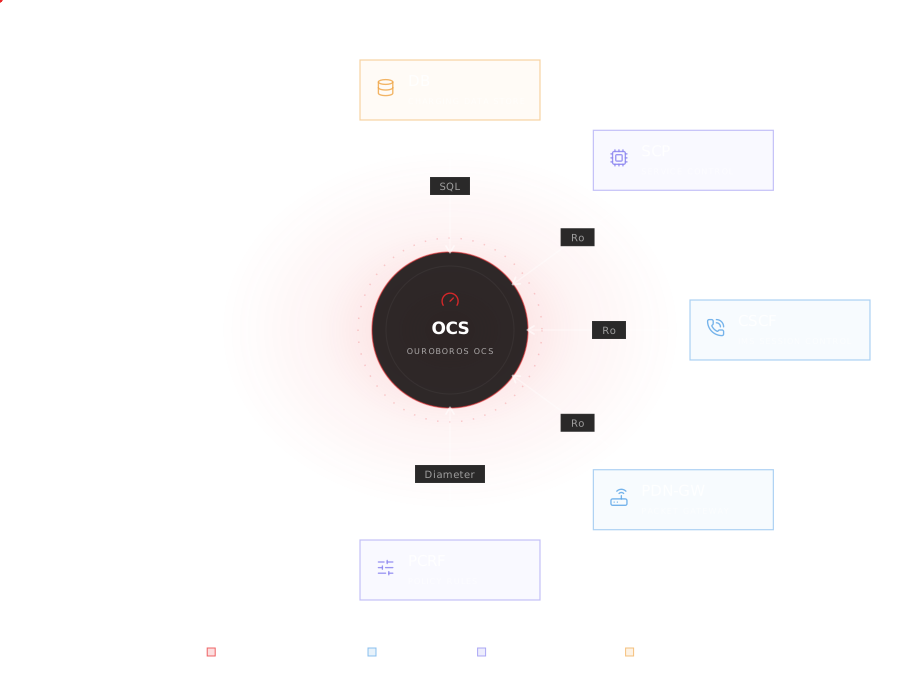
OCS — Ro charging interfaces across the core
Real-time prepaid, convergent charging, tariff launches, roaming rating — one OCS across every generation.
Real-time prepaid charging across generations
Voice, data, and messaging sessions on 2G through 5G request credit control over Diameter. The OCS reserves and debits in real time, preventing overspend on any service while balance is shared cleanly across concurrent sessions.
Unified subscriber and balance record
Because the OCS uses the UDR, each subscriber has one record carrying both profile and balance. A bar or a plan change made through the HSS is immediately reflected in charging — no synchronisation, no drift.
Convergent data charging (Gy / N40)
Data sessions from the PGW (Gy) or the 5G SMF via the CHF role (N40) reserve quota against the subscriber's data balance. Time and volume thresholds drive smooth quota replenishment without session interruption.
Promotional and dedicated balances
Operators run main, promotional, and dedicated-data balances with independent validity periods on the same subscriber. The OCS applies the correct balance per service and per tariff, all within the shared UDR record.
MVNE serving multiple MVNOs
An MVNE hosts charging for multiple MVNOs on one OCS, each with its own tariffs and balances, while sharing the HSS UDR per subscriber — one repository, many brands.

We've selected Ouroboros because it was the best company capable of fulfilling our need for a scalable and virtualised full MVNO platform. Moreover, the Ouroboros team is pragmatic, flexible and responsive.
Pascal Prot
CEO-CTO · Legos
Shared UDR — one record per subscriber
Subscriber identity, profile, and balance live in the same repository the HSS and PCRF uses. Charging always sees current subscriber state; there is no separate balance store to drift out of sync, action on limits doesn't need extra.
Real-time credit control over Diameter
Camel, Gy, Ro, and N40 requests reserve quota and report usage as sessions run. Prepaid subscribers cannot overspend, even across concurrent voice, data, and messaging sessions.
No synchronisation interface
Because profile and balance share one record, there is no HSS-to-OCS sync to build, monitor, or repair. A provisioning change made once is correct everywhere — no reconciliation batch, no drift window.
Multiple balances and validity periods
Main, promotional, and dedicated-data balances coexist on the same subscriber. Operators run flexible prepaid offers without separate accounts or external balance managers.
Convergent charging across generations
The same OCS charges 2G voice and 5G data through the appropriate Diameter interface. One charging system covers the whole network rather than one per generation.
Quota threshold management
Time and volume thresholds drive replenishment requests before quota is exhausted. Data sessions continue smoothly without mid-session interruption at quota boundaries.
Most charging deployments treat the subscriber as two entities — one in the HSS, one in the OCS — and then spend operational effort keeping them aligned. The Ouroboros OCS removes the second copy: it charges against the same UDR the HSS uses, so there is one subscriber record, one source of truth, and no synchronisation layer to fail.
For operators that already run the Ouroboros HSS, this is a natural consolidation: identity and charging on one repository, one platform, one support contract. For those on a third-party HSS, the OCS can be deployed against a shared UDR where the architecture allows. The OPEX rental model lets operators add real-time charging without capitalising a separate charging database.

Tell us your HSS, your current charging platform, and your prepaid service mix, and we'll show you what charging on a shared UDR looks like — and what reconciliation it removes.
 Product datasheet
Charging · Charging & Billing
Online Charging System (OCS)
A prepaid subscriber starts a call, a data session, and an SMS in the same minute. Each one has to check the same balance, reserve against it, and debit it — in real time, without double-spending. The Ouroboros OCS does that on the same UDR your HSS already uses, so subscriber identity and balance are one repository, not two systems to reconcile.
Shares the HSS UDR · In production since 2004 · 148M+ subscribers · OPEX rental available
Two systems, one subscriber, two truths
The HSS holds subscriber identity, profile, and provisioning state. The charging system holds balances, quotas, and rate plans. In most deployments these are separate products with separate databases — which means the same subscriber exists twice, and the two copies drift.
When provisioning changes in one system and not the other, sessions get authorised against stale data: a barred subscriber who still has balance, a balance that does not reflect a plan change, a profile update that never reached charging. Reconciliation jobs paper over the gap, but the underlying problem is architectural — subscriber data and charging data should not live in two repositories that have to be kept in sync.
Every event rated. Balance decremented in real time.
Call or session starts — OCS authorises the balance
The Ouroboros OCS performs real-time online charging — balance check, quota reservation, and debit — for prepaid voice, data, and messaging across 2G, 3G, 4G, and 5G. Network elements request credit control over Diameter: the OCF/SCP interface to the packet core (Gy for the PGW, N40 for the 5G SMF/CHF role) and Ro for IMS-based services. Each request reserves a quota against the subscriber's balance and reports usage back, so charging tracks consumption as it happens rather than after the fact.
Rating engine applies the plan — per-PLMN rules
What makes this OCS different is where the balance lives. Instead of its own subscriber store, the OCS uses the same UDR (User Data Repository) as the HSS. Subscriber identity, profile, and balance are held in one repository, accessed by both functions. There is one record per subscriber, not two: the HSS reads and writes profile and provisioning state; the OCS reads and writes balances, quotas, and rate-plan state — against the same subscriber entity.
Same OCS: 2G voice through to 5G data
The consequence is that charging always sees current subscriber state. A bar, a plan change, or a provisioning update applied through the HSS is visible to the OCS immediately, because it is the same record. There is no synchronisation interface to fail, no reconciliation batch to run, and no window where the two copies disagree.
The OCS handles the full charging lifecycle: balance management, multiple balances per subscriber (main, promotional, dedicated data), validity periods, quota replenishment thresholds, and rating against configurable tariffs. Recharge and top-up update the balance directly in the shared UDR.
OCS — Ro charging interfaces across the core
How operators use it.
Real-time prepaid, convergent charging, tariff launches, roaming rating — one OCS across every generation.
Real-time prepaid charging across generations
Voice, data, and messaging sessions on 2G through 5G request credit control over Diameter. The OCS reserves and debits in real time, preventing overspend on any service while balance is shared cleanly across concurrent sessions.
Unified subscriber and balance record
Because the OCS uses the UDR, each subscriber has one record carrying both profile and balance. A bar or a plan change made through the HSS is immediately reflected in charging — no synchronisation, no drift.
Convergent data charging (Gy / N40)
Data sessions from the PGW (Gy) or the 5G SMF via the CHF role (N40) reserve quota against the subscriber's data balance. Time and volume thresholds drive smooth quota replenishment without session interruption.
Promotional and dedicated balances
Operators run main, promotional, and dedicated-data balances with independent validity periods on the same subscriber. The OCS applies the correct balance per service and per tariff, all within the shared UDR record.
MVNE serving multiple MVNOs
An MVNE hosts charging for multiple MVNOs on one OCS, each with its own tariffs and balances, while sharing the HSS UDR per subscriber — one repository, many brands.
Specifications.
Inside the platform.
Shared UDR — one record per subscriber
Subscriber identity, profile, and balance live in the same repository the HSS and PCRF uses. Charging always sees current subscriber state; there is no separate balance store to drift out of sync, action on limits doesn't need extra.
Real-time credit control over Diameter
Camel, Gy, Ro, and N40 requests reserve quota and report usage as sessions run. Prepaid subscribers cannot overspend, even across concurrent voice, data, and messaging sessions.
No synchronisation interface
Because profile and balance share one record, there is no HSS-to-OCS sync to build, monitor, or repair. A provisioning change made once is correct everywhere — no reconciliation batch, no drift window.
Multiple balances and validity periods
Main, promotional, and dedicated-data balances coexist on the same subscriber. Operators run flexible prepaid offers without separate accounts or external balance managers.
Convergent charging across generations
The same OCS charges 2G voice and 5G data through the appropriate Diameter interface. One charging system covers the whole network rather than one per generation.
Quota threshold management
Time and volume thresholds drive replenishment requests before quota is exhausted. Data sessions continue smoothly without mid-session interruption at quota boundaries.
Most charging deployments treat the subscriber as two entities — one in the HSS, one in the OCS — and then spend operational effort keeping them aligned. The Ouroboros OCS removes the second copy: it charges against the same UDR the HSS uses, so there is one subscriber record, one source of truth, and no synchronisation layer to fail.
For operators that already run the Ouroboros HSS, this is a natural consolidation: identity and charging on one repository, one platform, one support contract. For those on a third-party HSS, the OCS can be deployed against a shared UDR where the architecture allows. The OPEX rental model lets operators add real-time charging without capitalising a separate charging database.
HSS
The OCS shares the HSS UDR. Subscriber identity, profile, and balance live in one repository accessed by both functions.
PCRF
Policy decisions from the PCRF and charging decisions from the OCS apply to the same subscriber sessions; both read the shared subscriber state.
Next step
Still reconciling subscriber data between your HSS and your charging system?
Tell us your HSS, your current charging platform, and your prepaid service mix, and we'll show you what charging on a shared UDR looks like — and what reconciliation it removes.